MojoStreaming
Wildlife Photo Contest ends May 21, 2021, 11:00 P.M. Est
We are inviting you to submit YOUR photo of wildlife for
a chance to be featured in our promotional calendar The photo we choose for our cover also will receive a $500 cash prize https://www.mojostreaming.com/signup Deadline to submit your photo is May 21, 2021, 11:00 EST Free
to sign up & submit
To kick off our introduction to MojoStreaming, a
Wildlife Community for photographers and filmmakers. We are inviting you to
submit YOUR photo of wildlife for a chance to be featured in our promotional
calendar (a great opportunity to promote your work) The photo we choose for our
cover also will receive $500. It is free to enter and simple to do: Upload your
image by May 21st before 11:00 P.M. EST (National Endangered Species Day) Sign
up & Submit at https://lnkd.in/epesgnf
Once you sign up- all you do is click on the Upload button
and choose the Photo for the calendar album.
PS do not forget to check your spam
folder for an email confirmation.
There is more good news! If your photo is
featured in the calendar - we will send you a free calendar!
ALL entries will be featured on Mojostreaming- a great way to gain additional exposure. To learn
more about us: https://www.mojostreaming.com/static/about
All photos must be original work, taken by the entrants. No
third party may own or control any materials the photo contains, and the photo
must not infringe upon the trademark, copyright, moral rights, intellectual
rights, or rights of privacy of any entity or person.
You
grant to MojoStreaming a non-exclusive, worldwide, royalty-free, sublicensable, and transferable license to use, copy, modify (size), distribute and publish
your photo(s) on our MojoStreaming Website and our Social Media Sites. Your photo(s) may be used for marketing and
promotional purposes. You represent and warrant that you own or have all
necessary rights (including intellectual property rights) to your photo(s)
(including to grant the license above).
Entries
will be judged by the MojoStreaming shareholders. All decisions are final. The Company reserves
the right to disqualify any entry that is deemed inappropriate or does not conform
to stated contest rules.
By
entering the contest, entrants agree that photos submitted can be used by the MojoStreaming
are for marketing purposes and may be featured in our promotional 18-month
calendar.
Submissions
will not be accepted once the deadline lapses: (May 21, 2021, 11:00 p.m. EST)
The
winner will be contacted via the email address sometime between June 1 -4th
provided during entry. If no response is received after five business days, a new winner will be selected, and the previous winner will forfeit all rights to
the prize.
We
will also contact all entries that will be featured in the calendar via the email
address sometime between June-1-4th provided during entry. At this time, we will ask that you provide us
further information about you, and more information about your photography
business/hobby. We will want to feature
information about you and your work so our customers can learn more about the
work you do.
If
you have any questions, please contact Cami Ciotta at cami@mojostreaming.com

“Have You Goat What It Takes?” Ask 14 Farmed Animal Sanctuaries
Competing in the 2022 Goat Games
Happening August 12-15, The Third Annual Goat Games Inspires Friendly Competition Among 14 Farmed Animal Sanctuaries Nationwide and Their Animal Champions
SAUGERTIES, N.Y. July 27, 2022 – Here we “goat” again! Catskill Animal Sanctuary (CAS), one of the world’s leading sanctuaries for farmed animals, is pleased to announce that it will host the third annual Goat Games. From August 12-15, CAS will be joined by 13 additional farmed animal sanctuaries located throughout the U.S. that will rally the support of animal lovers nationwide in support of their life-saving work. To register or make a donation, visit thegoatgames.org.
While the goats don’t actually compete, human athletes can sign up for an activity of their choosing – “whatever floats your goat!” – to raise awareness and funds for the sanctuary team of their choice. Participants can join this nationwide, virtual event from anywhere in the U.S.
“Covid did a number on us, as it did on nonprofits around the world,” said Kathy Stevens, Founder of Catskill Animal Sanctuary. “Funding plummeted, while the urgent needs of hundreds of animals remained the same. So in 2020, we created The Goat Games as a way for animal lovers to support the work of farm sanctuaries and the thousands of animals who call these special places home. We’re thrilled to host The Goat Games again to raise funds for farmed animals everywhere— and that need is more urgent than it’s ever been.”
Stevens explained that not only are sanctuaries “just digging out, in year three” of the pandemic, but they’re doing it at a time when the cost of everyday supplies is through the roof. “Grain cost is up. Hay cost is up. Medical supply costs are up. The cost of building materials is so high that a contractor suggested we not build anything.”
The Goat Games is a virtual event that challenges human participants to run, walk, bike, hike, or complete any activity of their choosing to raise money for a participating sanctuary. Each sanctuary has selected a farm animal as their team captain, and “athletes” will rally behind the farmed animal representing the sanctuary they want to support.
“We want to inspire animal lovers around the country to participate,” said Stevens. “Do whatever it is that you love – whether it’s running, reading, volunteering or binge-watching Netflix! Once folks pick their activity, they simply invite friends and family to support them as they raise funds for their favorite sanctuary.”
In its first year, Catskill Animal Sanctuary raised over $42,000. In 2021, CAS expanded The Games, inviting nine other farmed animal sanctuaries across the country to join, as a way to build camaraderie and increase national awareness of their life-saving work. The consortium raised over $217,000 to help rescued farmed animals. This year, they hope to increase that figure to $260,000.
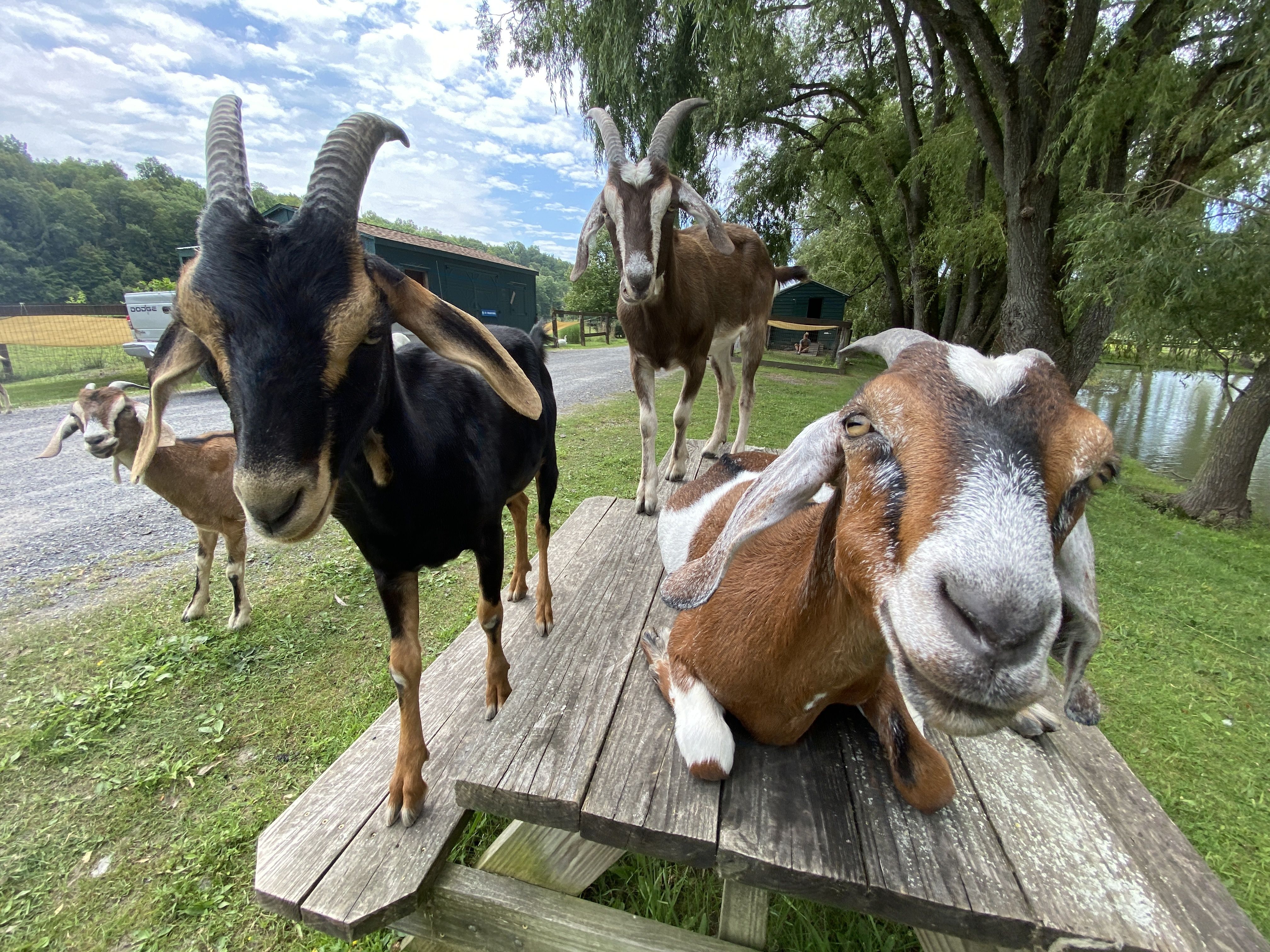
The participating sanctuaries in the 2022 Goat Games include:
· Catskill Animal Sanctuary - the hosting Sanctuary (Saugerties, NY)
· Alaqua Animal Refuge (Freeport, FL)
· Farm Sanctuary (Watkins Glen, NY & Acton, CA)
· Farmaste Animal Sanctuary (Lindstrom, MN)
· Heartwood Haven (Wauna, WA)
· Indraloka Animal Sanctuary (Mehoopany, PA)
· Iowa Farm Sanctuary (Oxford, IA)
· Kindred Spirits Sanctuary (Citra, FL)
· Little Bear Sanctuary (Punta Gorda, FL)
· Piedmont Farm Animal Refuge (Pittsboro, NC)
· River’s Wish Animal Sanctuary (Spokane, WA),
· Safe Haven Rabbit Rescue (Clinton, NJ)
· Wildwood Farm Sanctuary (Newberg, OR)
· Yesahcan Sanctuary, Inc. (Arcadia, FL
Funds raised through donations and sponsorships will support the life-saving mission of each participating sanctuary. For more information on The Goat Games 2022 including registering and/or making a donation, visit thegoatgames.org.
About Catskill Animal Sanctuary
Founded in 2001, Catskill Animal Sanctuary is a non-profit, 150-acre refuge in New York's Hudson Valley. It is home to eleven species of rescued farmed animals with between 275 and 400 residents at any given time. In addition to direct animal aid, the Sanctuary offers on-site tours, a weekly podcast, an award-winning vegan cooking program, and educational programs that advocate veganism as the very best way to end animal suffering, improve human health, and heal an ailing planet.
Catskill Animal Sanctuary is the only U.S. farmed animal sanctuary with highest honors and accreditations from:
Charity Navigator (4 Stars), GuideStar (Platinum Rating), Better Business Bureau, and GFAS: Global Federation of Animal Sanctuaries
For more information, call (845) 336-8447 or go to www.casanctuary.org.
-End-
Media Contact Information:
Lauren Witt, Account Supervisor
(817) 721-5576
catskillanimalsanctuary@Interdependence.com
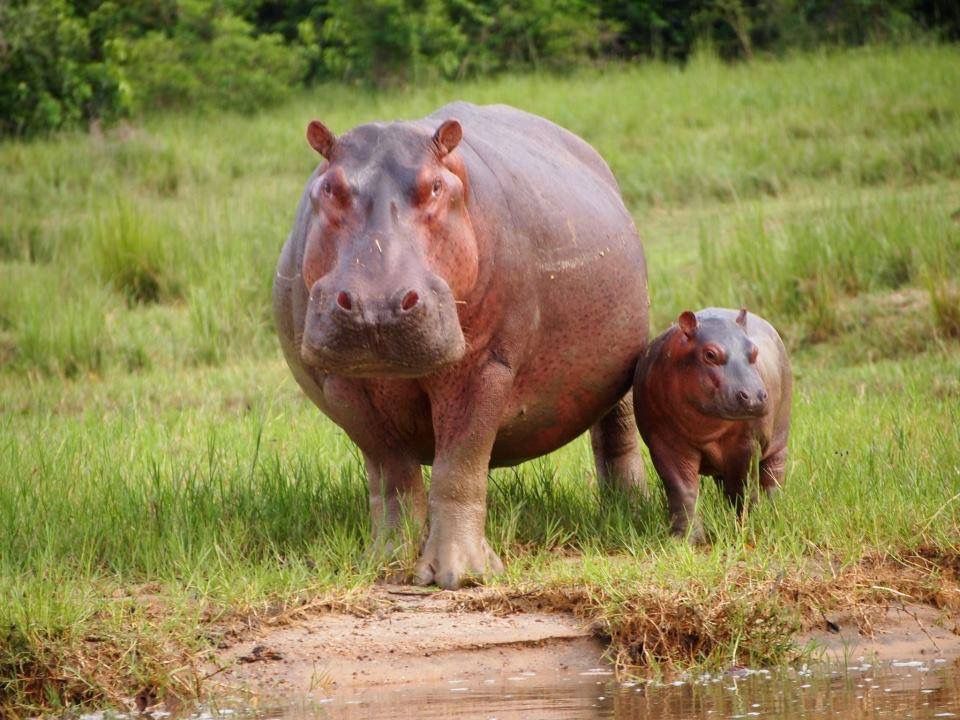
Hippopotamus is also commonly known as Water-Horse. Hippos are the third-largest land mammal after the elephant and the rhinoceros. Weighing in at 1,500–1,800 kg (3,300–4,000 lb.), an adult male stands up to 1.5m (4.5 feet) at the shoulder, and, oddly enough, their closest living relatives are whales and dolphins. Hippos spend most of their days submerged in water to keep cool, as they have no sweat glands.
Though they have webbed feet, their huge bulk prevents them from floating and they cannot swim. Their size does not, however, prevent them from outrunning a human - hippos have been estimated to reach terrifying speeds of up to 30 or even 40km per hour on land.
An adult hippo can spend as long as six minutes underwater, and their raised eyes, ears and nostrils allow them to remain almost entirely submerged for long periods of time. After spending the day bathing, hippos venture out at dusk and spend the night grazing, travelling up to 8km (5 miles) and consuming up to 68kg (150lbs) of grass each night to maintain their enormous size.
When hippos sleep in the water during the day they generally prefer to sleep in areas of shallower water. They are not standing or floating when you see them sleeping but rather laying flat on their bellies. Despite being semiaquatic and having webbed feet, an adult hippo is not a particularly good swimmer nor can it float. It is rarely found in deep water; when it is, the animal moves by porpoise-like leaps from the bottom.
#AfricantripswithGodie
#visitUgandarwandatanzania #Mammalsofeastafrica
The Black-and-white-casqued Hornbill is distributed to evergreen forests and savanna across equatorial Africa, in central and western Africa.
Females have a smaller casque and a black bill. The purpose of the casque is unknown for males, although suggested to be for sexual characterization.
The black-and-white-casqued hornbill has very mobile eyes which is not a common trait in birds.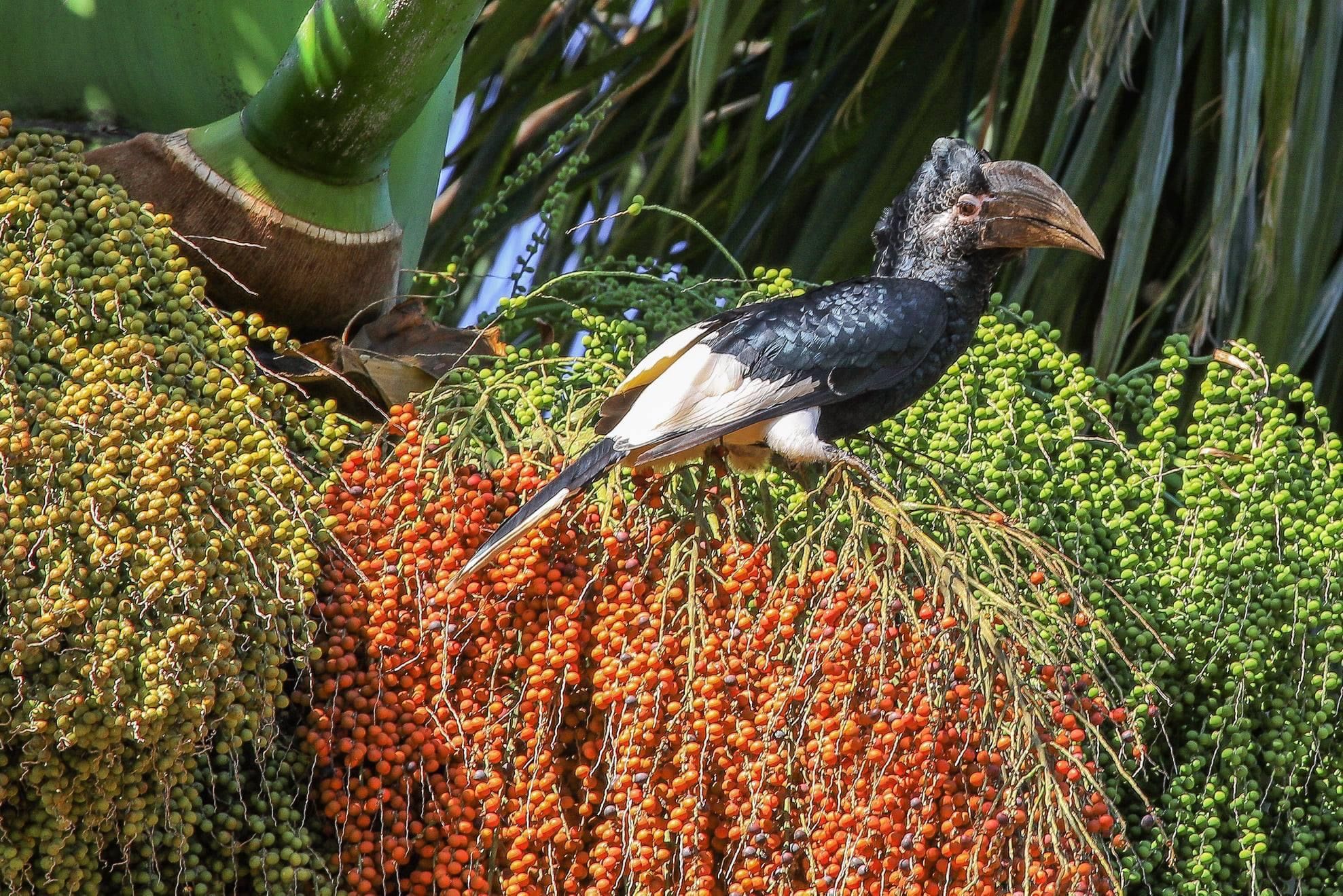
This means that its eyes themselves can move in their socket, while other birds tend to have to move their heads to see.
It is capable of displaying emotions through the feathers at the top of the head, which allows it to communicate its emotional state.
Black-and-white-casqued hornbills are quite vocal, with a large repertoire of calls, one of which can be heard from a distance of 2km.
A monogamous species. Pairs commonly nest in naturally formed cavities 9 to 30 m high in large (>3 m circumference) rainforest trees.
Due to the rarity of these nesting cavities, there is a high degree of intraspecific competition for nesting sites. In order to protect their nest, pairs seal the cavity with mud pellets collected by the male. Inside, the female lays a clutch of 2 eggs, which are white in color with pitted shells. The eggs are incubated for 42 days while the male delivers food to the female hourly through a small slit, regurgitating numerous fruits, mammals, and insects. The male can bring up to 200 fruits per visit.
Usually, only one offspring is reared, with the chick from the second-laid egg dying of starvation. Newly hatched chicks have pink skin and open their eyes at 20 days of age. The offspring fledge in 70 to 79 days and can feed themselves by 40 to 72 days after fledging.
The diet consists mainly of figs, fruits, insects, and small animals found in the trees. Black-and-white-casqued hornbills are mainly frugivorous, with fruit comprising 90% of their diet, 56% belonging to Ficus species. They forage by hopping from branch to branch in the rainforest canopy and reaching for fruit with the tip of the bill, which they then swallow whole. This species is known to consume over 41 plant genera. The black-and-white-casqued hornbill does not consume water directly and seems to instead hydrate itself from the water contained in the fruits that represent most of its diet.
Black-and-white-casqued hornbills mediate seed dispersal of rainforest trees, by defecating or regurgitating seeds.
Carnivores, apes, monkeys, snakes, raptors, and humans all prey on these hornbills.
#Birdsofeastafrica
#visituganadarwandatanzania
Mojostreaming an online wildlife
network dedicated to bringing our viewers the latest wildlife stories,
entertainment, and opportunity to experience wildlife in its natural state.
The pandemic has dampened our
tourism and the opportunity for people to travel abroad. Mojostreaming wants to bring this experience into
your home.
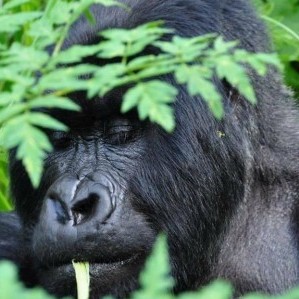
Tracking the mountain
gorillas through the misty forest (for example) requires patience and stamina
often walking for hours in the mud and wet. Finally meeting them in the
undergrowth is an inspiring moment. Quietly chewing away at their vegetarian
delicacies, they seem like a marooned human family.
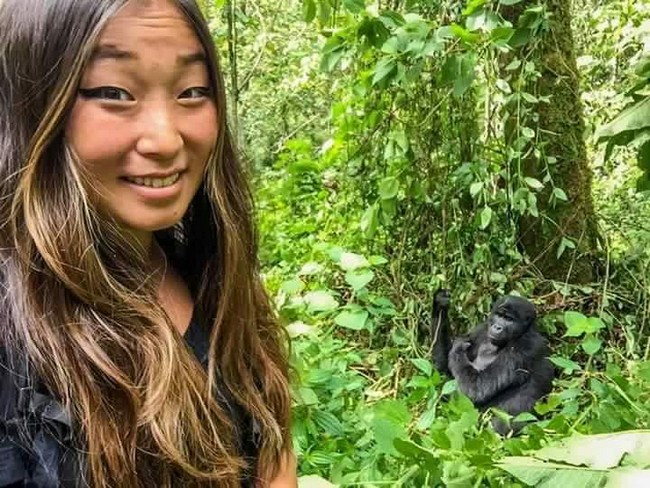
Image provided by Interior Safaris SE - Forest Walk Safaris Collection
Interior Safaris East Africa
tours provide experience, convenience, professional local guides giving you the
highest standards of hospitality with Gorilla and Chimpanzee tracking along
with other tour activities. On May 15th
at 2:00 P.M. EST Mojostreaming will air a 40-minute lecture titled “The
Endangered Apes” with Safari Guide &Tour
consultant:
GODFREY T
ELASMUS,
Director, Interior safaris East Africa,
Safari Guide &Tour consultant
He is an expert and guide for
the Gorilla Safari tour with Interior Safari East Africa
The gorilla permits cost USD
600, it is valid for one day and for one person. There is high demand for the
permits because of the high number of people who track the gorillas. Therefore, obtaining permits well in advance
it recommended but since traveling is not recommended at this time MojoStreaming
will bring a unique online live streaming experience of a 6-hour virtual tour
to track the gorillas right from your home. This will be available exclusively to
Mojostreaming viewers for free on May 22nd at 2:00 Est Time. We invite you to register for both events by
emailing your interest in attending to
Cami Ciotta at cami@mojostreaming.com
You then will receive your free URL
link to attend this unique and educational online event.
Keep in mind we will like for
you to be on time for your lecture “The Endangered Apes” which will begin at
2:00 P.M. on May 15th we suggest you sign on a few minutes BEFORE
2:00.
Even though we suggest
participating in the full 6-hour virtual tour into the safari to track the
gorillas, we understand this may not be possible and you can join the tour at any time during the stream. This will take place beginning at 2:00 P.M. on May 22nd.
Due to our introductory of
our live-streaming channel and introduction of our new services we are offering
both events for free. Please keep in
mind that we are testing our live-streaming program and we want to thank you in
advance for being part of this test.
We kindly ask that you make
a donation and/or tip to your guide at http://interiorsafarisea.com/donate/
and we ask that you become a loyal viewer of MojoStreaming and visit often to
be involved with our upcoming wildlife events at www.mojostreaming.com